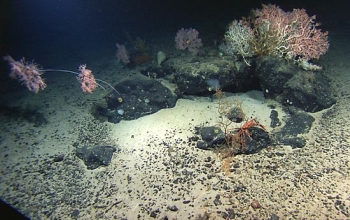
Ever
thought of the possibility of any type of organism to live under water? Well if
you did; that thought was indeed true. Dr. Roy, a geomicrobiologist fro the
university of Aarhus had gathered a sample of a high concentrated layer of
sediment under the sea; about 100 feet below the surface. The location this
took place was on the north pacific gyre off Hawaii. As they were gathering
their samples, they were hoping to find any microbes or even tracks of microbes
existing 100 feet below surface. Unable to gather any specific organism or
microbe, they were able to find signs of microbes that were living in the layer
that had retrieved. Dr. Roy had colleagues help him with his research,
especially with the calculations on how much oxygen should have been present
from the sample.
 “Microbes just observed used just 0.001
femtomoles of oxygen per day.” In other words the amount of oxygen they consume
for 10 years is equal to the amount a human inhales in a single breath. As the research
goes on, it was mentioned that these organisms have been part of our lives
longer than we can imagine; way before the dinosaurs went extinct. The researcher
mentioned that they are really slow at consuming oxygen; which turns into
energy for the microbes, are at minimal energy levels. Going on to say they are
living at the border of hunger limits. As these microbes are fairly new to any
research and yet so hard to study for their slow movement. Makes all of these
comments to be assumptions. Not actually being facts. Thus forcing the reader
to believe one side and forcing bias. There may be other things deep down in the
sea that could potentially have caused the oxygen numbers to be different as
well. Not only microbes. It is hard to tell because studies have not gone far
into the waters. Could be something to look forward in the future.
“Microbes just observed used just 0.001
femtomoles of oxygen per day.” In other words the amount of oxygen they consume
for 10 years is equal to the amount a human inhales in a single breath. As the research
goes on, it was mentioned that these organisms have been part of our lives
longer than we can imagine; way before the dinosaurs went extinct. The researcher
mentioned that they are really slow at consuming oxygen; which turns into
energy for the microbes, are at minimal energy levels. Going on to say they are
living at the border of hunger limits. As these microbes are fairly new to any
research and yet so hard to study for their slow movement. Makes all of these
comments to be assumptions. Not actually being facts. Thus forcing the reader
to believe one side and forcing bias. There may be other things deep down in the
sea that could potentially have caused the oxygen numbers to be different as
well. Not only microbes. It is hard to tell because studies have not gone far
into the waters. Could be something to look forward in the future.
Picture link: http://graphics8.nytimes.com/images/2012/05/22/science/22OBMICRO2/22OBOX2-articleInline.jpg
Article link: http://www.nytimes.com/2012/05/22/science/deep-sea-microbes-that-barely-breathe.html?_r=0

No comments:
Post a Comment